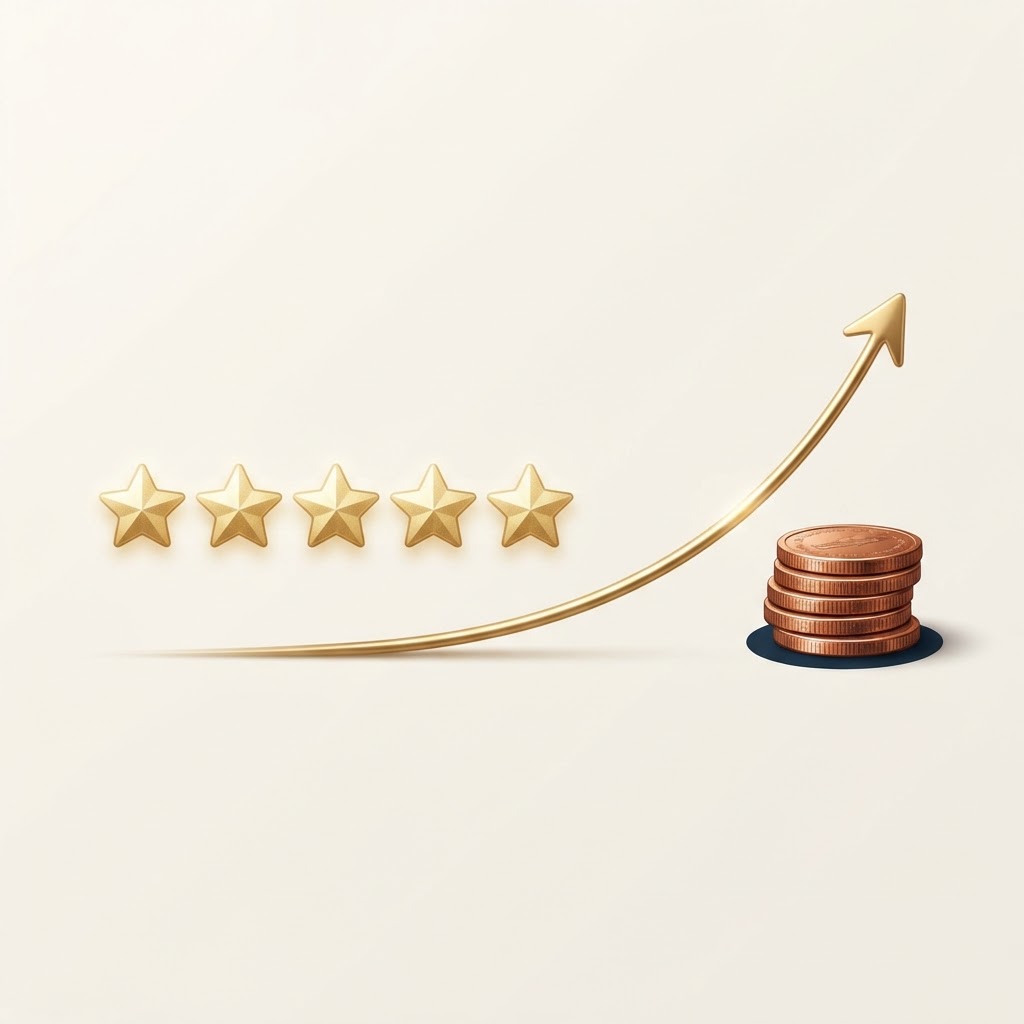
Most restaurant owners sense that reviews matter. What is less widely understood is how much they matter — and how directly a profile's rating and freshness translate into booked covers and walk-ins. Here is what the accumulated research and industry data say.
The star rating is a threshold, not a slope
Studies of consumer behaviour consistently find a step change around the ratings customers treat as acceptable. Diners filter out businesses below roughly four stars before they even read a word. Between 4.0 and 4.5 is where the biggest marginal gains sit: the jump from 3.9 to 4.3 can materially change how many people even consider your restaurant. Above roughly 4.7, additional fractions of a star make little difference — at that point, people are choosing between you and two other excellent options on price, menu, and photos.
Count matters as proof, freshness matters as rank
Two numbers drive your local visibility:
- Review count works as social proof — 400 reviews says "many people have been here"; 12 says "be careful". Customers trust volume.
- Review velocity — recent reviews — is widely seen as important to local ranking. A profile that went quiet eight months ago signals a business that may have changed hands or declined, even if the lifetime rating is strong.
The revenue maths
Harvard Business School's well-known study of Yelp data found each one-star improvement predicted a revenue increase of roughly 5–9% for independent restaurants. Local SEO studies have found that moving into the Google "local 3-pack" can multiply profile views several-fold, since most searchers never scroll past the first three map results. The exact numbers vary by study and market, but the direction is unambiguous: your profile is one of your highest-leverage marketing assets, and unlike your food or your rent, its quality is largely within your control.
Photos and owner replies compound the effect
Profiles with recent photos get dramatically more engagement, and Google's own guidance points to photos and reply activity as ranking and engagement factors. Replying to reviews — including the critical ones — signals an active, cared-for business. It costs nothing but a few minutes a week, which is precisely why so few competitors do it consistently.
The honest caveat
Reviews are earned, not manufactured. The businesses that win long-term are the ones that treat review generation as a gentle, constant process — making it easy for genuine customers to share real experiences while the food does the heavy lifting. Anything that strays into fake, incentivised, or gated reviews eventually unravels: platforms detect it, customers smell it, and the recovery is far harder than the shortcut was worth.
Where to start this week
If your profile has gone quiet: first, reply to your last ten reviews. Second, put a direct review link or QR code where your happiest customers already are — the table, the bill, the exit. Third, look at your reviews-per-month rather than your total, and aim for steady growth. Small, consistent actions beat a big campaign every time.
Revly exists to make step two effortless — see the live QR review demo or read our full guide to getting more reviews.