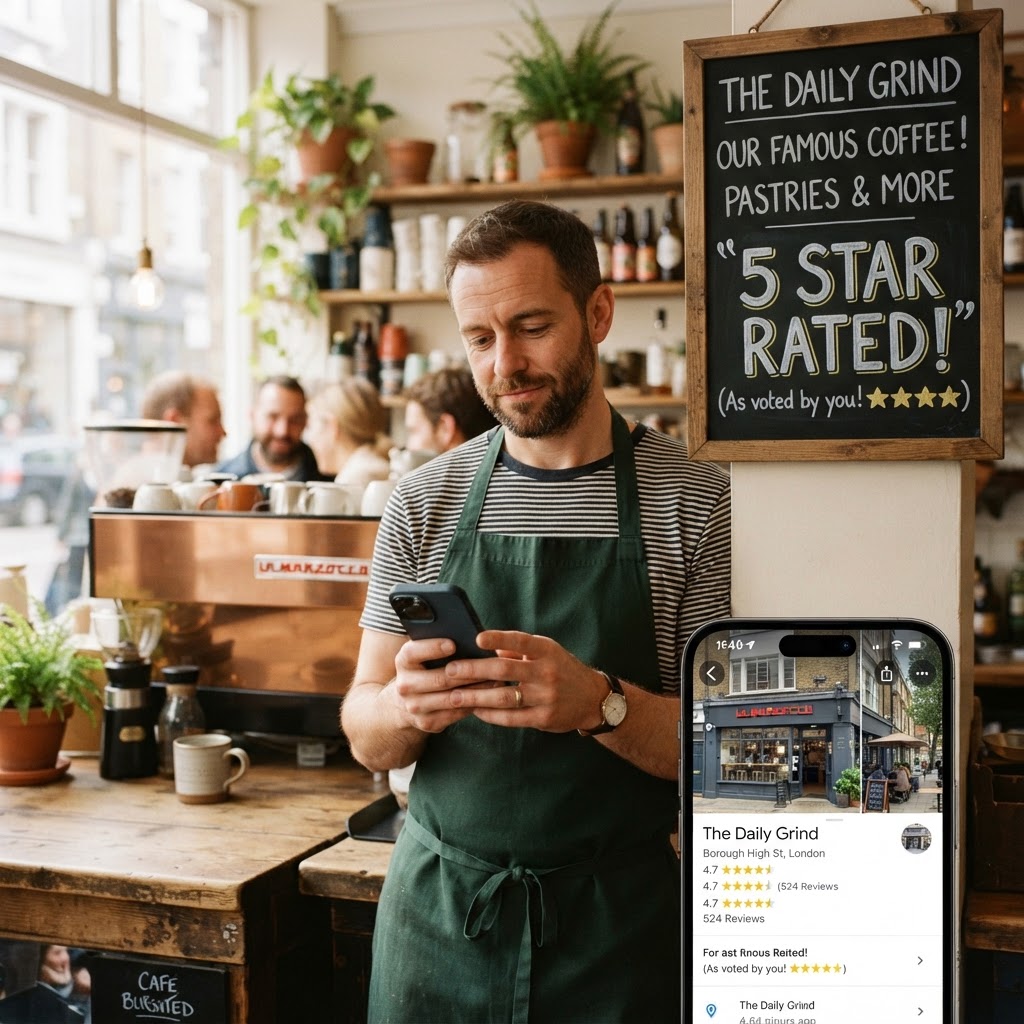
Yes — but only while the claim is true, typical and provable. UK advertising rules let a café or restaurant shout about its Google rating, provided the wording matches the evidence: an accurate average, a fair sample, and dated proof you kept before those words went anywhere near a menu, poster or Instagram bio.
Most venues never have a problem, because most claims are small and true. Trouble comes from the gap between a proud claim and what the reviews actually show — a chalkboard shouting five stars over a 4.4 average, or a window sticker printed in a better month. Keeping the two aligned is the whole job, and every rule below exists to help you do that.
Where the rules come from
Two layers govern review claims in the UK. The first is the advertising code administered by the Advertising Standards Authority: any claim that customers rely on when choosing you — including menus, window vinyls, flyers and social posts — must be substantiated, with the evidence in your hands before you publish. The second is consumer law: the Consumer Protection from Unfair Trading Regulations 2008 make misleading claims a criminal offence, and the Digital Markets, Competition and Consumers Act 2024 tightened the review side of that law, banning practices such as commissioning or publishing fake reviews.
The practical meaning is simple. A review-based claim is treated like any factual claim in an advert: the business making it is responsible for holding proof, not for producing excuses afterwards.
What counts as a review claim?
Explicit claims are the obvious ones: “5-star rated”, “best café in London”, “highest-rated brunch on this street”. Each is a factual statement about ratings, and each needs evidence behind it. “Best” and “highest” add another layer, since superlatives raise the question of what you were measured against.
Implicit claims count too. A five-star badge on your door, a single glowing review blown up on a poster, or a star graphic on a sandwich board all communicate “customers rate us five stars” even without words. Cherry-picking one perfect review and printing it large, while dozens of ordinary reviews sit unmentioned, invites the same challenge the written claim would.
Accuracy drifts on its own. A sign printed honestly at a perfect 5.0 becomes quietly wrong after a handful of four-star weeks take the average to 4.6. Nobody lied, yet the claim is now misleading by omission — which is why dated, renewable claims beat permanent ones.
Three checks before the words go on the menu
- Verify the average, on the day. Open your Google Business Profile, read the number, and write it down. “Rated 4.8 on Google” with the stated number is a claim you can prove; “5-star rated” rounded up from 4.8 is not.
- Weigh the sample, not just the score. Twelve five-star reviews out of twelve reads one way; three five-star reviews out of a total of four reads another. Averages from a thin or lopsided set of reviews are easier to challenge, and regulators ask whether a claim reflects the typical customer experience.
- Keep dated evidence. Screenshot the rating with the date and review count visible, save it in a folder, and repeat monthly. Evidence collected before publication is what the rules ask for; a screenshot scrambled together after a complaint looks defensive.
Print has a long shelf life, and ratings do not. A claim with a date attached — “Rated 4.9 on Google, October 2026” — stays honest longer than a bare boast, because the reader can see exactly when it was true and judge for themselves.
Menus, posters and Instagram bios
Safe wording leans on specifics rather than superlatives: “Read our Google reviews” with a link, “Rated 4.8 on Google” with the date checked, or simply “Over 200 Google reviews”, which needs no editorialising at all. Specific claims age predictably and can be checked with one glance at your profile; vague ones cannot be verified by anyone.
Award claims follow the same logic with two extra requirements. “Voted Best Café 2026” should name the awarding body somewhere nearby, because an unverifiable award is just decoration with a risk attached. Genuine certificates can be displayed as they are — originals are their own evidence.
Digital claims forgive; print does not. A bio can be corrected in a minute, but a laminated poster with an inflated rating stares at every customer until the next print run, and reprinting six months early is a genuine cost for a small venue. Treat printed claims as a budget line, and date every one of them.
If someone complains
Complaints go to two places. The ASA handles misleading advertising — its rulings are published and effectively binding, and adverts must be withdrawn or corrected once a complaint is upheld. Trading Standards enforces consumer law, using the misleading-claims rules against businesses that ignore warnings. Both routes usually begin politely; both expect the claim to change, not a debate about wording.
The proportionate response matters as much as the claim. A single outdated chalkboard corrected the same week reads very differently from a business that defends a visibly wrong claim. Fix the wording, keep the correction date, and the paper trail largely closes itself.
Keeping the claim honest as reviews change
Averages move constantly, and the venues that cope best do two things. First, they refresh dated claims on a fixed cycle — monthly for anything on display, before every print run for anything permanent. Second, they keep a steady flow of genuine reviews arriving, so the average is defended by volume rather than luck; our guide to getting more Google reviews without begging covers the quiet ways to do that, from a review link printed on bills to a card by the till.
Buying reviews to protect a claim is not a shortcut — it is the specific practice consumer law now bans, and platforms tend to remove the fakes anyway, leaving the claim looking worse than before. Our write-ups on why bought reviews backfire and the legality of fake reviews in the UK cover that ground in detail.
Claim what your reviews can support, date anything permanent, keep the evidence, and refresh before the average moves away from the poster. Honest claims travel furthest anyway — a real 4.8 with two hundred reviews behind it persuades customers more than a borrowed five ever could.