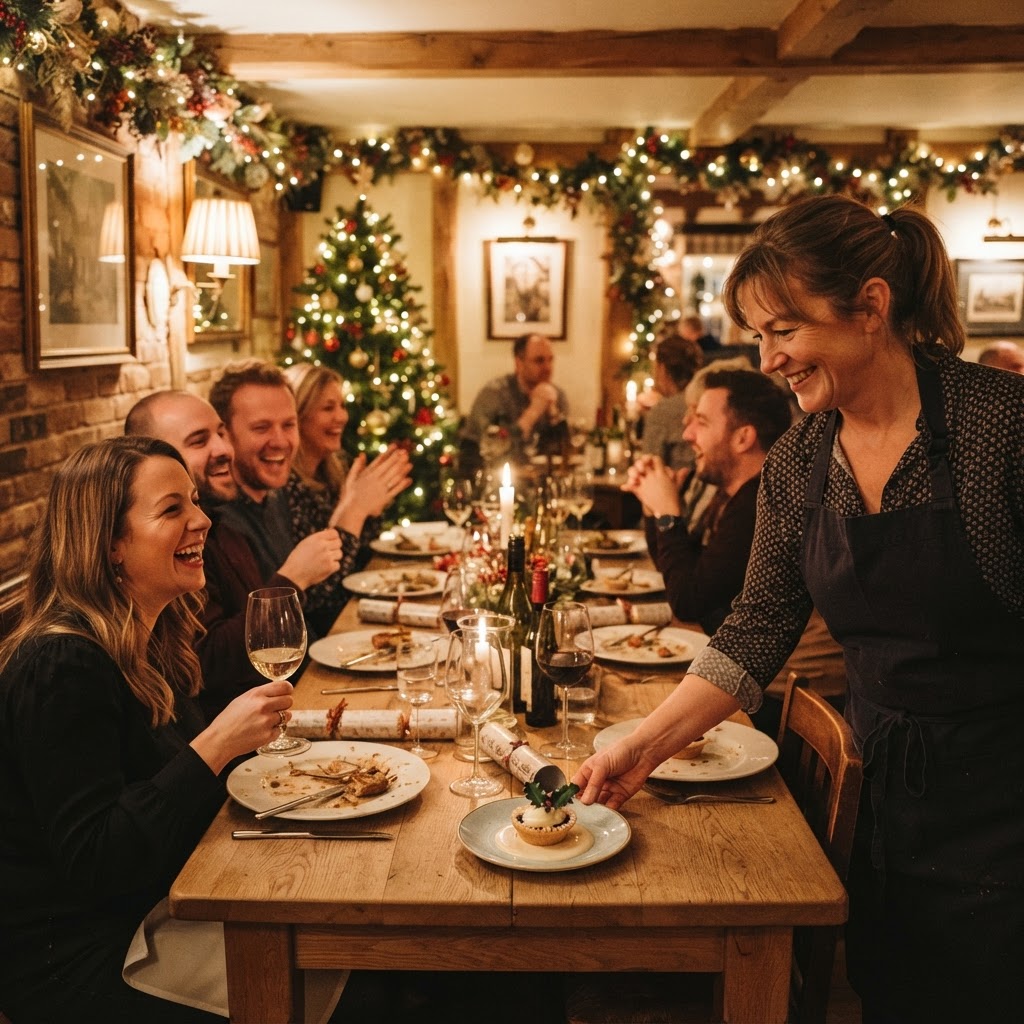
For most UK restaurants, cafés and bistros, December is the biggest trading month of the year. Office parties, family get-togethers, the annual catch-up with friends you only see at Christmas — the bookings stack up in a way no other month matches. Yet how good your December turns out to be is largely decided long before the decorations go up. The venues that have a brilliant festive season are almost always the ones that started planning in October, while everyone else was still recovering from the summer rush.
Here is a practical plan built around the things that genuinely move the needle: the offer itself, being findable, the people who already know you, and what you capture while the room is full.
Why the plan starts now, in October
Christmas demand arrives earlier than most owners expect. The person organising the office Christmas dinner usually starts looking in October and has a shortlist by early November. Families deciding where to go "somewhere nice before it all gets busy" book through November. If your party menu and prices are not published and visible by then, you are not in that shortlist — you are in the scramble for whoever is left in mid-December.
There are practical reasons too. Anything printed — menus, table talkers, window posters — needs artwork and a print run that finishes before December, not during it. Staffing rosters have to work around annual leave requests, which means knowing your party bookings well in advance. And your own headspace: decisions made calmly in October are better than decisions made in the middle of the rush.
Put the offer on paper: party packages that sell themselves
Vague enquiries wither. Concrete packages book. The venues that fill their December tend to publish a small set of clear options rather than "ring us to discuss". A workable set looks like this:
- A set party menu at two or three price points — for example a light bites and drinks package, a two-course lunch, and a three-course evening dinner — priced per head, with a few dishes chosen in advance by the organiser or a fixed festive menu for the table.
- A small welcome included — a glass of fizz or a soft-drink alternative on arrival. It costs little and sets the tone for the whole booking.
- Clear house rules — minimum group size, the date by which final numbers are due, and a small per-head deposit taken with the booking. Deposits are standard practice across the industry for good reason: no-shows are expensive, and a deposit filters out the bookings that were never serious.
- A bigger option — full or partial private hire of the back room for the one or two parties per season that want it, priced so it is worth your while to close off the space.
Write all of it down — on your website, on a one-page PDF you can send from your phone, and in the confirmation email. The easier you make the organiser's job, the more likely they are to say yes on the spot.
Update your Google Business Profile first
When people search "Christmas menu" or "Christmas party venue" near them, the starting point is usually Google. Your Google Business Profile is the most valuable square metre of digital real estate you own, and at Christmas it needs seasonal attention:
- Add photos of the room decorated and tables laid for a party — people book what they can picture.
- Make sure your website link goes to a page where the Christmas packages are visible, not to a homepage where they have to hunt.
- Use GBP posts or updates in November to announce the menu launch and party availability, and again in early December for last availability.
- Check festive opening hours are correct — holiday closures and bank holiday hours confuse exactly the customers you most want in the door.
Work the list: the cheapest marketing you own
You do not need a big email list — a few hundred past customers is plenty, because at Christmas they are unusually ready to hear from you. If you have not started collecting emails, begin now: every party enquiry and every regular who says "lovely, we must come back" is an email waiting to be asked for.
Three well-timed emails beat daily blasts of festive noise:
- Early November: the announcement. The Christmas menu is live, party bookings are open, and weekends go first. One clear page link, no essays.
- Late November: the availability reminder. Which dates are left, and what the smaller group options are for people who find booking for twenty a bit much.
- Mid-December: gift vouchers. More on those below — they are the best-kept secret of a good January.
Make December work for the rest of the year: reviews
December brings you more customers in a few weeks than most venues see in a quiet quarter, and every one of them is a potential review. Reviews posted during the festivities keep working long after the tinsel is down: they are what strangers read in January and February when they are deciding where to try this year. A room that is full of happy tables and collects no reviews is leaving its busiest fortnight's worth of reputation on the table.
The playbook does not need to be complicated — ask warmly as groups settle up or leave, and make scanning effortless with a card on the table or at the till. For the exact approach, scripts and placement, see how to ask customers for a Google review. Party organisers are worth an extra ask — one happy office review travels.
Allergens and odd diets: solve them in November, not on the night
Party bookings bring unfamiliar requirements — the vegan in the office, the gluten-free cousin, the nut allergy nobody mentioned until ten minutes before service. The calm way to handle it is preparation:
- Publish the party menu with allergen information, and label which dishes can be adapted. If you sell pre-packed items for direct sale, remember the UK's Natasha's Law labelling rules — our plain-English UK allergen guide covers the fourteen allergens and what applies to a small venue.
- Brief the team in November: one page, laminated, by the pass — which dishes are safe for which allergen, and who answers the question if the server is unsure.
- A digital QR menu earns its keep here: update a sold-out dish or a substituted ingredient instantly, everywhere, without reprinting a hundred paper menus.
A week-by-week checklist
- Mid-October: packages, prices and deposit terms agreed. Menu artwork started. Google Business Profile updated with festive photos. Email list started or refreshed.
- Early November: Christmas menu live on the site and on your profile. Announcement email sent. Printed menus and table talkers in the venue. Staff briefed on the menu and the words to ask for a review.
- Late November: availability reminder email. Party slots confirmed with final numbers and dietary notes collected. Allergen brief done.
- December: run the service, ask for reviews while tables are happy, and in the last two weeks push gift vouchers to every group that settles up.
- Early January: email everyone who booked: a thank you, and a reason to return in the quiet weeks — voucher holders are the perfect excuse.
Gift vouchers: December's gift to January
Gift vouchers are the one piece of Christmas marketing that pays you twice. Sold as presents in late December, they bring revenue in immediately and guarantee visits in January and February — the weeks when independent venues most need a reason for the room to be warm. Keep them simple: a card or a printed voucher with a value and a validity window, offered everywhere customers pay, and mention them once on social media and in the December email. They cost next to nothing to run and soften the fall from a full December to an empty midwinter.
If updating the festive details still means reprinting everything, that is the part worth fixing first: a digital menu takes the sold-out dish down the same evening and never needs a print run, and a fast, clean website shows your Christmas packages off to the people searching for them. Revly helps independent restaurants and cafés do exactly that — QR review cards, digital menus that update in seconds, and websites that load fast. See the demo or get in touch.