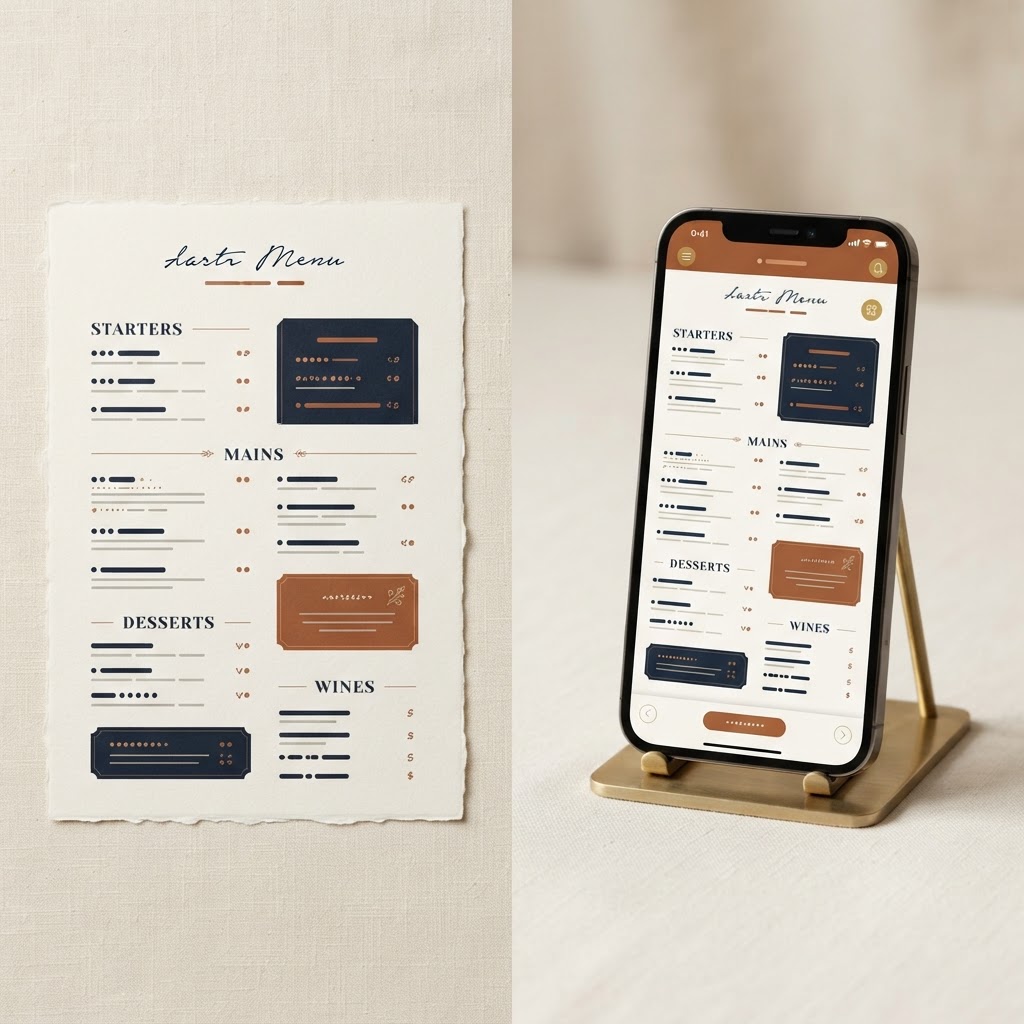
Every restaurant switches menus more often than it admits: a supplier hikes a price, a dish is 86'd, a seasonal special arrives. Each change has a cost, and the menu format you choose decides whether that cost is a reprint or a two-minute edit. Here is the honest comparison.
The printed menu's real cost
A run of quality printed menus for a 60-cover restaurant typically runs £150–£400 per reprint — plus design time, proofing rounds, and the gap between "the price changed on Monday" and "the new menus arrived on Thursday". Over two years with four reprints, most venues spend £600–£1,600 on printing alone. Laminated menus soften the cost but date badly and scuff visibly.
Print's strengths are real: it needs no phone, suits older customers, feels premium in the hand, and never shows a loading spinner. These strengths argue for keeping print in circulation — not for letting it carry your only copy of the truth.
The digital menu's real cost
The honest costs of digital are: the build (anywhere from free DIY to a professional one-time build), the habit of updating it, and the occasional customer who prefers paper. What digital is not, in 2026, is a monthly subscription necessity — a menu you own outright with no recurring fee is entirely achievable, and the maths over two years is not close: a one-time professional build versus £600+ in reprints, and the digital version is editable at 9pm the same evening.
Where the numbers really diverge: change itself
The hidden cost of print is not the money — it is the decisions it silently prevents. Venues on printed menus run "wrong" prices for weeks because a reprint is not worth it, decline to add a promising special because the menu cannot hold it, and delay removing a dish they no longer want to sell. Digital menus make change free, and free change is how kitchens stay experimental.
Allergens and dietary information
Printed menus struggle to carry full 14-allergen and dietary detail without turning into a legal document. Digital menus carry per-item allergen flags, vegan/gluten-free/halal tags, and ingredient notes without cluttering the design — and update instantly when a supplier changes an ingredient.
What customers prefer (both, in different moments)
Diners browsing before choosing a venue overwhelmingly prefer digital — it is how they research. Diners at the table are split: many love the phone option, and a loyal minority want paper. The winning venues keep a small stack of printed menus for those who ask, and lead with the QR code for everyone else (our complete QR code menu guide covers implementation in detail). Treat it as addition, not replacement.
The two-year verdict
For most independent restaurants, the economics and the flexibility point the same way: a professionally built digital menu as the primary, a short stack of printed menus as the backup, and a review of the digital menu at every supplier change. The printed-only status quo is the most expensive option on the list — it just hides its costs in reprints and roads not taken.
Revly builds one-time-fee digital menus with UK allergen structure and your branding — see the live example.